We are meant to serve but also to be served.
Breadwinners, stars, and bratty children want everything done for them. They want to be served because they think themselves special with special priveleges.
On the other hand, there are those who are continually serving, attending to the every need of everyone. They carry a false martyrdom, of being the good one and the loving one.
Then, there are those who neither want to serve and be served, carrying the badge of self-sufficiency.
The acts of serving and being served do not necessarily mean HUMILITY or ARROGANCE. Peter was rebuked for not wanting his feet to be washed by Jesus. The apostles were rebuked when they did not want Mary to wash the feet of Jesus with perfume.
Jesus says, "If I wash you not, you shall have no part with me." Serving and not wanting to be served can be acts of self-centeredness and can be self-serving. Pope Benedict XVI connected acts of charity in the service of Truth. "Caritas in Veritate 79: Development needs Christians with their arms raised towards God in prayer, Christians moved by the knowledge that TRUTH-FILLED LOVE, caritas in veritate, from which authentic development proceeds, is not produced by us, but GIVEN TO US. For this reason, even in the most difficult and complex times, besides recognizing what is happening, we must above all else turn to God's love."
For the modern times, the "washing of the feet" had been focused on service and humility. For St Augustine, the "washing of the feet" also meant a continuing SPIRITUAL WASHING - cleansing as we engage in public life. Such cleansing is necessary even after the regeneration brought about by our Baptism.
The point is this: guilt must not be allowed to FESTER in the SILENCE of the SOUL, poisoning it from within. It needs to be confessed. Through confession, we bring it into the light, we place it within Christ's PURIFYING LOVE (cf Jn3:20-21). In confession, the Lord washes our soiled feet over and over again and prepares us for TABLE FELLOWSHIP with Him."Benedict XVI, Jesus of Nazareth vol2, p74)
Thus, "to serve and be served" is to "be blessed and be a blessing". In communion with God, we can be in communion with others. As God becomes an integral part of our life, our individual persons can be integrated with humanity in harmony, serving each other physically and spiritually.
":not telling God what to do, but learning to ACCEPT HIM as He reveals Himself to us; noy seeking to exalt ourselves to God's level, but in HUMBLE SERVICE letting ourselves be slowly REFASHIONED into God's true Image."Benedict XVI, Jesus of Nazareth vol2, p72)

Showing posts with label Holy Week. Show all posts
Showing posts with label Holy Week. Show all posts
Wednesday, March 27, 2013

Monday, March 25, 2013
Holy Week- to Die with Jesus
There is always a dying in each of us. A sense of losing a part of us. It could be a loss of meaning and purpose due to lack of direction, physical sickness, or just that emptiness. It could be a sense of not knowing who we are. There is a LOSS. There is SOMETHING MISSING.
But there is also a holy death that brings forth life, a re-creation, a transformation. We know and we believe Jesus died and resurrected. This is our holy death - to experience Christ Crucified in our suffering and the suffering of others.
"As the cross of Christ demonstrates, God also speaks by his SILENCE. The silence of God, the experience of the distance of the almighty Father, is a decisive stage in the earthly journey of the Son of God, the incarnate Word. Hanging from the wood of the cross, He lamented the suffering caused by that silence: ' My God, my God, why have you forsaken me ( Mk 15:34; Mt 27:46). Advancing in obedience to His very last breath, in the obscurity of death, Jesus called upon the Father. He commended himself to him at the MOMENT of PASSAGE, through death, to eternal life: 'Father, into your hands I commend my spirit' ( Lk 23:46)." (Benedict XVI, Verbum Dei)
We all experience pain. Yet, it is a loud call that beckons, or even begs us to accept the love of God. When we do, we, in turn, can continue to love, to hope, to believe. Our life, even in suffering, becomes a prayer. This experience of dying is not limited to sickness. Parents, most esp mothers, would know the pain of going through this passage to new life. In Pope Benedict XVI, he must have experienced this, too, when he accepted the papacy. And moreso when he renounced it.
"Yet at the same time, Jesus' suffering is a Messianic Passion. It is suffering in FELLOWSHIP with us, in a solidarity - born of love- that already includes redemption, the VICTORY of LOVE." (Benedict XVI, Jesus of Nazareth vol 2, p 216)
With the Cross, God loved me and you. He fought the battle with us and for us. He conquered death with new life.
“And so it turns out that the confrontation with physical death is actually a confrontation with the basic constitution of human existence. It places before us a choice: to accept either the PATTERN of LOVE, or the PATTERN of POWER. The God who personally died in Jesus Christ fulfilled the pattern of love beyond all expectation… The Christian dies into the death of Christ himself. The uncontrollable Power that everywhere sets limits to life is not a blind law of nature. It is a LOVE which puts itself AT OUR DISPOSAL by DYING FOR US and WITH US. Man’s enemy, death, that would waylay him to steal his life, is conquered at the point where one meets the thievery of death with the attitude of trusting love, and so transforms the theft into the increase of life.” (Joseph Ratzinger, Eschatology: Death and Eternal Life)

But there is also a holy death that brings forth life, a re-creation, a transformation. We know and we believe Jesus died and resurrected. This is our holy death - to experience Christ Crucified in our suffering and the suffering of others.
"As the cross of Christ demonstrates, God also speaks by his SILENCE. The silence of God, the experience of the distance of the almighty Father, is a decisive stage in the earthly journey of the Son of God, the incarnate Word. Hanging from the wood of the cross, He lamented the suffering caused by that silence: ' My God, my God, why have you forsaken me ( Mk 15:34; Mt 27:46). Advancing in obedience to His very last breath, in the obscurity of death, Jesus called upon the Father. He commended himself to him at the MOMENT of PASSAGE, through death, to eternal life: 'Father, into your hands I commend my spirit' ( Lk 23:46)." (Benedict XVI, Verbum Dei)
We all experience pain. Yet, it is a loud call that beckons, or even begs us to accept the love of God. When we do, we, in turn, can continue to love, to hope, to believe. Our life, even in suffering, becomes a prayer. This experience of dying is not limited to sickness. Parents, most esp mothers, would know the pain of going through this passage to new life. In Pope Benedict XVI, he must have experienced this, too, when he accepted the papacy. And moreso when he renounced it.
"Yet at the same time, Jesus' suffering is a Messianic Passion. It is suffering in FELLOWSHIP with us, in a solidarity - born of love- that already includes redemption, the VICTORY of LOVE." (Benedict XVI, Jesus of Nazareth vol 2, p 216)
With the Cross, God loved me and you. He fought the battle with us and for us. He conquered death with new life.
“And so it turns out that the confrontation with physical death is actually a confrontation with the basic constitution of human existence. It places before us a choice: to accept either the PATTERN of LOVE, or the PATTERN of POWER. The God who personally died in Jesus Christ fulfilled the pattern of love beyond all expectation… The Christian dies into the death of Christ himself. The uncontrollable Power that everywhere sets limits to life is not a blind law of nature. It is a LOVE which puts itself AT OUR DISPOSAL by DYING FOR US and WITH US. Man’s enemy, death, that would waylay him to steal his life, is conquered at the point where one meets the thievery of death with the attitude of trusting love, and so transforms the theft into the increase of life.” (Joseph Ratzinger, Eschatology: Death and Eternal Life)
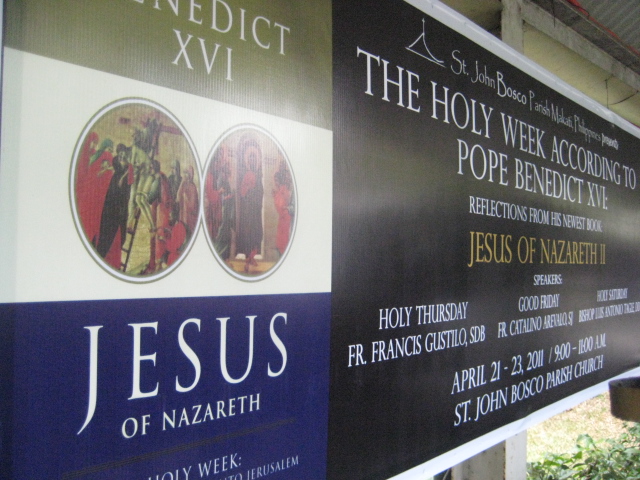
Holy Week Thru Pope Benedict XVI
The time of Lent is
commemorating the passion, death, and resurrection of Jesus Christ. It speaks of the tremendous love of God for
humanity. Lent is a call to repentance,
fasting, and alms giving; It is the constant call of God to each of us to
journey with Him, in Him, and through Him.
The aging process brings new
dimension to things, and with the devaluation of life around us in a culture of
death. I, now, meditate on the Holy
Week through the eyes of a mortal man, Benedict XVI. To die with Jesus.
“I will simply be a pilgrim who is beginning the last part of his pilgrimage on earth.” (Benedict XVI, March 28, 2013)
Good-byes are always
difficult. It cuts through our hearts –
the HOLDING ON and the LETTING GO of good-byes. That is good-bye in whatever form,
whether physical death, geographical separation, or end of a relationship. The
significant other is responding to a call.
For someone like Pope Benedict XVI, it is definitely, a response to
God’s call.
“The Lord is calling me to ‘climb the mountain’, to devote myself even more to prayer and meditation.” (Benedict XVI, March 24, 2012, Final Angelus)
And in all of Benedict XVI’s
writings, everything in life is about an encounter with Jesus – with God.
“As pilgrims, we go up to Him; As a pilgrim, He comes to us and takes
us up with Him in his ‘ascent’ to the Cross and Resurrection, to the definitive
Jerusalem that is already growing in the midst of this world in the communion
that unites us with His body.” (Benedict XVI, Jesus of Nazareth,
vol 2)

There is always that point
of intimate contact with God, so much like Michelangelo’s painting of the
creation. A reaching out of hands to
the point of touching. Not just God’s but also our hands.
But then, there is always
that inescapable CROSS that we have to face.
Abandonment, betrayal, failed aspirations, physical sickness… that we
would rather drown in the accumulation of things, whirlwind of activities, fame
and fortune.
“[Mount of Olives]: it was
here that Jesus experienced the final loneliness, the whole anguish of the
human condition. Here the abyss of sin
and evil permeated deep within his soul. Here He was to quake with foreboding
of His imminent death. Here He was kissed by the betrayer. Here He was
abandoned by all the disciples. Here He wrestled with His destiny for MY SAKE.”
(Benedict XVI, Jesus of Nazareth, Vol 2, p 149)
Subscribe to:
Posts (Atom)